
Living Questions
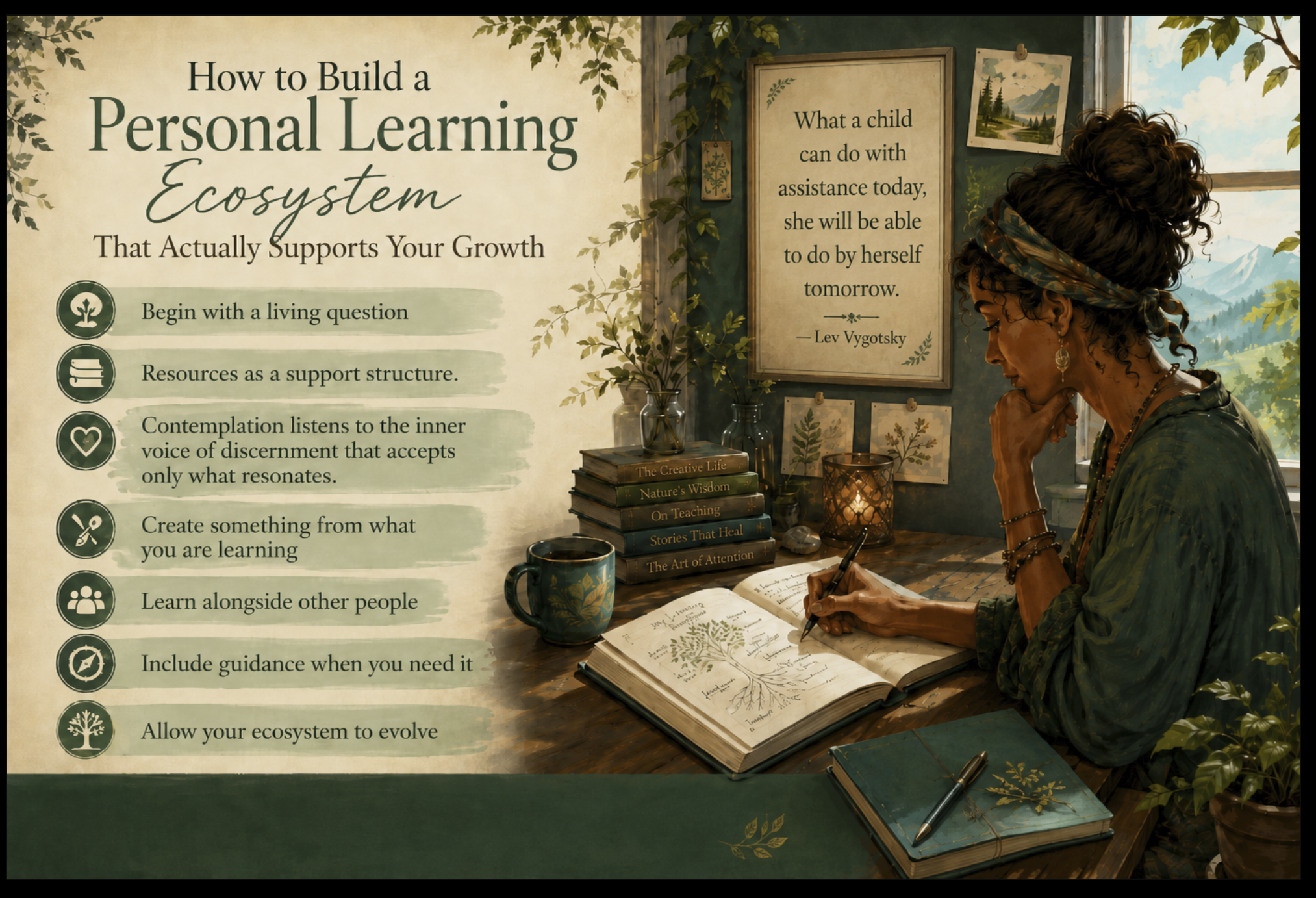
“A living question does not need an immediate answer. It gives you a thread to follow.”
Reflection
A meaningful learning journey usually begins with a question rather than a curriculum.
Questions come and go as you contemplate a matter. The living questions stick. At least they do for me. They stay around for days, months, sometimes years, becoming a portal to discovery. Following those portals are my favourite kind of adventures.
That is why I think it is worth cultivating a curious mind. The biggest challenge is to stay focused!
For me, curiosity is the beginning of adventure, and sometimes it leads to genius. At least that is what AI tells me. It is the tiny seed from which an entire tree can grow.
Looking back over my own life, the learning that changed me most never began with someone else’s lesson plan. It began because I couldn’t stop wondering about something. That question followed me into books, conversations, dreams, classrooms, gardens, and long walks. This is why I am inviting you to generate questions and watch for the ones that keeps returning. They are what I call “living questions”.
Gather Your Tools
As we move ahead together, you may notice yourself becoming a more intentional learner.
Up until now, you may only have only needed a device and an internet connection. Now I’d invite you to add more traditional tools—a notebook or journal, a pen or pencil and maybe a whole set of colours too.
A living question needs somewhere to live. That is where the traditional tools come in. I’ll write more about this later. Your questions don’t demand an immediate answers. The discipline of catching them and tracking them is already something. Awareness. The more you focus on your conscious process, and make it visible in our 3d world, the more it grows.
Start collecting:
- What questions have quietly followed you through this season of your life?
- Pause for a moment to catch them. Did you catch any?
- How do the questions arrive?
- Like a feather?
- Like a stone?
- Like a bomb?
- Somewhere in between?
Write it down.
If another question follows, write that one down too.
Perhaps a doodle wants to appear beside it.
Keep your pen on the page.
Take one slow breath.
Don’t try to answer the question.
Simply notice what comes.
Sometimes nothing happens.
Sometimes the pause will bring a pivot and a question will move the world, like the fulcrum, it is the fixed point around which a lever pivots.
Golden Curiosity
Something interesting begins to happen once you start working with living questions.
- Books seem to jump off shelves.
- A podcast appears at exactly the right moment.
- Someone recommends a course.
- A friend says something you weren’t expecting.
It can almost feel as though your question is quietly organizing your attention.
Of course, those resources were probably there all along.
The difference is that now you notice them.
I call this living on the “Emergent Edge”. I will write more about this soon. (Let me know if you are interested!)
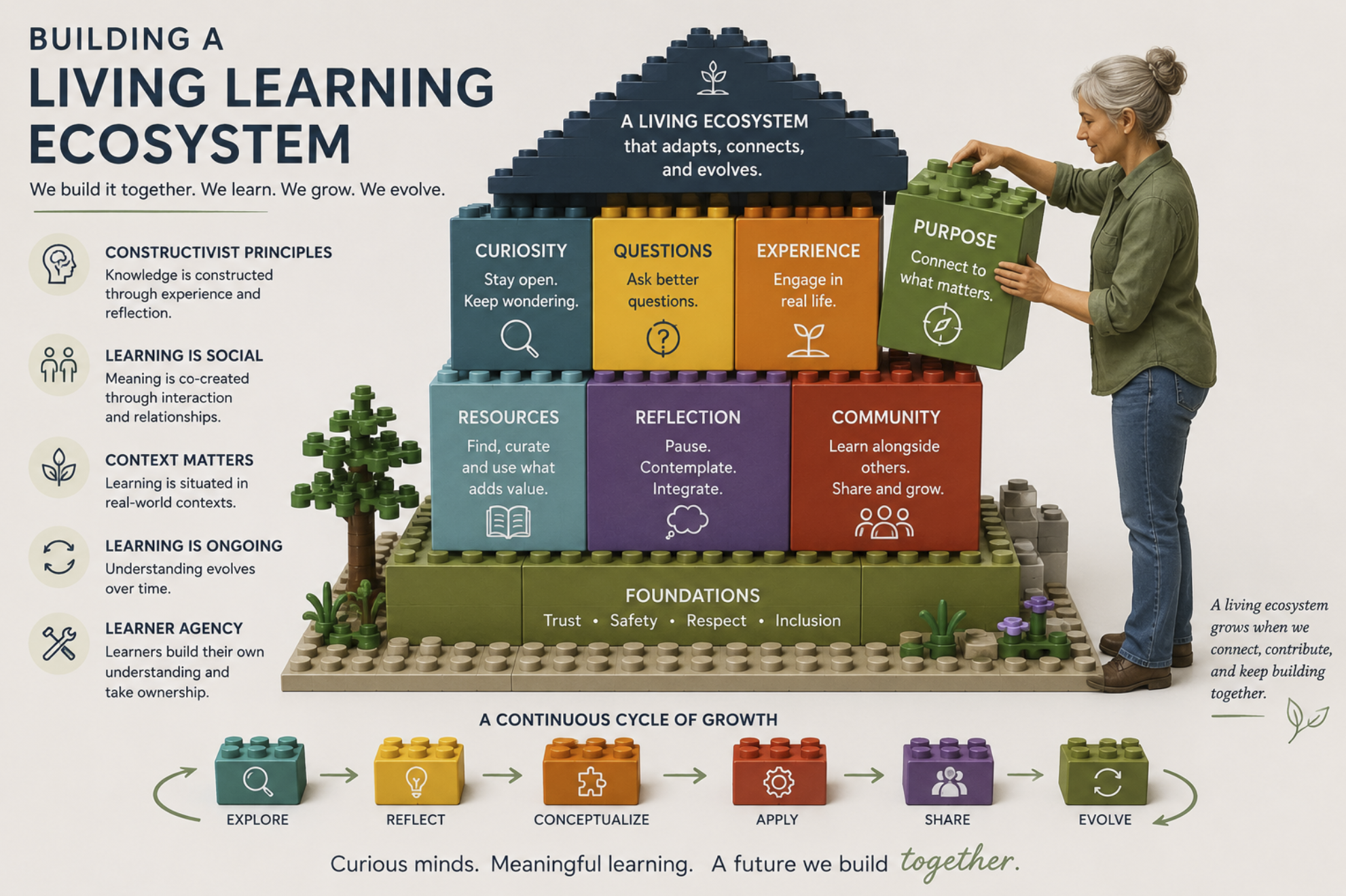
Learning from the living questions becomes less about collecting information and more about constructing meaning. Each new experience becomes another piece in your own living learning ecosystem.
A World of Information
We live in an extraordinary moment in history. Last week I wondered about how to design a garden bed that does not consume large amounts of water. When I looked it up, I had articles, documentaries, photographs, and scientific papers available to me. I used to bring home books from the library, and buy books. Now I no longer bother to search in a book. An article recently written is right at my fingertips.
One of my heroes, Leonardo da Vinci, never had that luxury. He loved generating questions. His genius was his focus! While he generated questions and some sources say it was as many as 50 a day! The evidence of his great productivity suggests that he stuck close to his living questions.
Leonardo’s Living Questions
Leonardo da Vinci (1452–1519) lived in a very different world. Without search engines or online courses, he relied on careful observation, his five senses, and relentless curiosity.
His notebooks contain wonderful questions like these:
- Describe the tongue of the woodpecker.
- Why is the sky blue?
- Describe the muscles that move the lips.
- How does the heart work?
- Why do fish move as they do?
He rarely accepted appearances at face value.
He trained himself to notice.
To ask.
To investigate.
His genius wasn’t simply that he found remarkable answers. It was that he cultivated remarkable questions. And that is our challenge too!
Cultivate Your Genius
Tomorrow morning, set aside ten to twenty minutes.
Sit quietly and let your questions come.
Don’t worry about writing fifty.
Five is enough.
One may change your life.
If you need somewhere to begin, perhaps ask:
- How can I become more creative?
- How can I understand my dreams?
- How can I bring more meaning into my teaching?
- How can I create a course from what I already know?
- How can I live in a way that is more connected to nature?
- Where do I feel resistance?
- How would I explain my favourite subject to a twelve-year-old?
Don’t rush toward answers. Live with the questions for a while. Doodle. Write with your non-dominant hand. See where they lead.
Reflection
At the end of the week, return to your list and highlight the question—or questions—that feel most alive.
Time has a way of shifting our energy. Some questions quietly fade. Others continue to call us.
What endured for you?
Did your living questions attract anything?
- A conversation.
- A book.
- A dream.
- An unexpected connection.
Sometimes the most important changes are the ones that happen within us.
Sometimes an inner change sparks a new question.
Sometimes a living question sparks the change.